

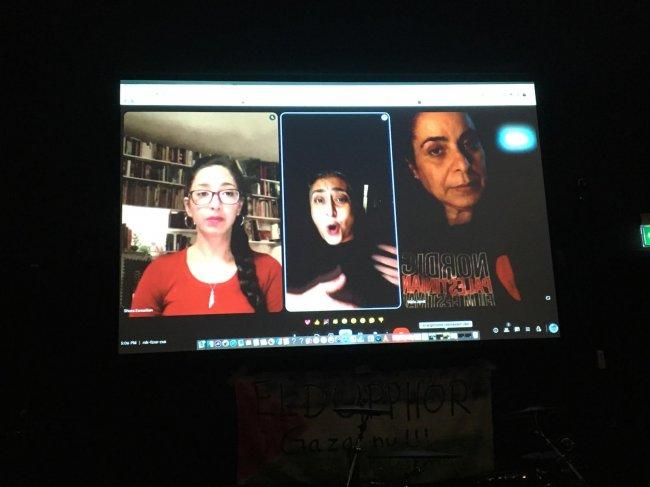
On 28–29 November, the Nordic Palestinian Film Festival took over Gotlands Kulturrum in Visby for two intensive days of film screenings, discussions, culture, and community engagement. In its second year, the festival highlighted Palestinian stories through a rich program of documentaries, short films, Q&As, and conversations with filmmakers, journalists, doctors, and human rights advocates.
The festival opened on Friday evening, 28 November, with “Stew for Gaza,” coffee, and an information area. Festival founder and film director Wafa Jamil welcomed the audience before the first film block began. The documentary The Last Doctor Standing was screened, produced by Al Jazeera 360 followed by a conversation with Märit Halmin, a doctor with Health Workers for Palestine who had spent the summer working in Gaza. Halmin described her experience as profoundly affecting:
“When I stood at the border crossing, I was shocked by the total destruction. Despite the catastrophe, people came to work and stood by my side every day. There are no words to express what I feel for them.”
The evening concluded with poetry, music, and a social gathering.
A Saturday of In-Depth Conversations and Storytelling
Saturday featured a full program from 13:30 to 22:00. After Wafa Jamil’s opening remarks, the documentary A state of Passion was shown, followed by a block of three short films under the title Maria, and a conversation with journalist Bisan Adwan and writer Shora Esmailian.
Esmailian reflected on the media and political climate:
“When it comes to Palestinians, Western governments and media fall silent. Freedom of speech does not apply to those who stand in solidarity with the Palestinian people.”
Bisan Adwan expanded on her experience as a journalist:
“As a journalist in war, you are expected to report without the tools or protection given to others. But we continued to tell the stories because we are messengers to the world.”
Later in the afternoon, the film To My Father was screened, followed by a Q&A with director Salam Shehada, who described his creative approach:
“I wanted to capture how occupation affects the small details of daily life. It was both technically and emotionally challenging, but also one of the most rewarding experiences.”
The day closed with the film block Orange from Jaffa, followed by poetry, music, and conversation.
Food, Community, and Local Engagement
Throughout the festival, “Stew for Gaza” and Palestinian-inspired refreshments were available, provided by Kulturmums Ferment & Catering. All food and snacks were offered for voluntary donations to the Palestine Groups' emergency fund. Visitors also explored an information corner featuring books, pins, keffiyehs, and resources on how to get involved.
Svenska Freds Gotland (Swedish Peace) was on-site, offering insights into international law and human rights. The session What Can One Do on Gotland? provided concrete information on local avenues for activism through community organizations.
A Cultural Forum Beyond Politics
Festival founder Wafa Jamil emphasized that the festival was a cultural space dedicated to storytelling—not a political platform:
“This year, we focused on human stories. In the midst of the ongoing genocide in Gaza, we especially wanted to highlight films about journalists and healthcare workers who worked on the front lines. The festival was a place for art, culture, and human voices.”
She concluded with the festival’s motto:
“Breathe the Air of Freedom with us – Nordic Palestinian Film Festival.”
Organizers
The festival was organized by Sard Films, Swedish Peace Gotland, Gotland for Palestine, and Kulturmums Ferment & Catering, in collaboration with Al Jazeera 360, Studiefrämjandet Gotland, Gotlands Kulturrum, and with support from Film på Gotland.

.jpeg)
.jpeg)
.jpeg)
