

Nordic Palestinian Film Festival Held in Växjö: A Day of Film, Memory, and Resistance
The Nordic Palestinian Film Festival (NPFF) brought Palestinian cinema and storytelling to Växjö this week, in collaboration with Palladium Folkets Bio, Fria Ordets Hus, and the Linnaeus University Centre for Concurrences in Colonial and Postcolonial Studies.
Opening the festival, Liv Nilsson Stutz, Professor of Archaeology at the Department of Cultural Sciences, Linnaeus University, welcomed the audience and highlighted the importance of cultural exchange and collaboration.
.jpeg)
“We are very honored and happy to be partnering up and engaging with the NPFF”, she said. “I’m very happy to have you here. We’re looking forward to a full day of films and a seminar at the end of the morning session. And so, without further ado, because I know we have a rich program and some very interesting conversations ahead.
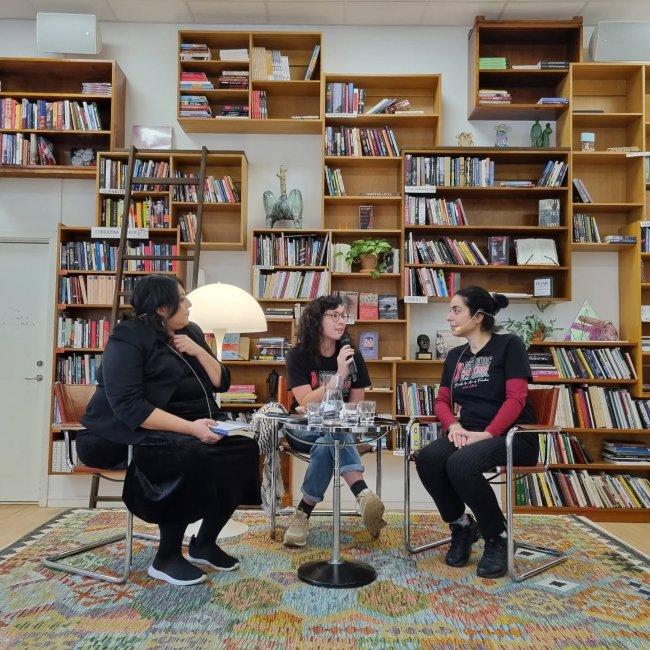
The day opened at Palladium with To My Father (2008) by Salam Shehada, a deeply personal documentary reflecting a cameraman journey between the 1950 to the second Intifada. Following the screening, a panel discussion titled “Storytelling, Memory and Resistance in Palestine” featured Rebecca Duncan, Bisan Adwan, and Wafá Jamil, who shared powerful reflections on how poetry, journalism, and film can serve as acts of remembrance and resistance.
During the discussion, Bisan Adwan spoke movingly about the impact of displacement on Palestinian identity and storytelling. She recalled telling her grandmother that everything in their family home had changed — a conversation that deeply affected her grandmother, who later passed away. Through this personal memory, Adwan illustrated how the loss of place is intertwined with the loss of history and belonging. She emphasized the importance of preserving Palestinian memory through novels and literature, keeping history alive in words when land and homes are taken away.
AFter Fria Ordets Hus, the festival continued with an afternoon of screenings highlighting new and emerging Palestinian voices. The program included A State of Passion (2024) by Carol Mansour and Muna Mhalidi, Maria (2025) by Abdelhakim Majed Abudaqen, Ahmad Alive (2024) by Yusuf Omar, Message (2024) by Saeed Moltaji, and a series of short films such as An Orange from Jaffa by Mohammed Almughanni, Forget Me Not by Mohammed Al Majdalawi, and Things Fall Apart by Mohammed Nayef Ahmed Ali.
“Through film, we reclaim our narratives and create a shared space for reflection,” said NPFF festival director Wafá Jamil. “Art helps us see beyond borders — it keeps memory alive and turns storytelling into a collective act of resilience.”
Each film offered a unique perspective on Palestinian life — from exile and displacement to love, loss, and endurance. Together, they created a cinematic landscape of resistance and belonging, reflecting the power of art to bear witness and connect communities across geographies.
The festival concluded with short documentaries including Walking with Gaza by Samer Abdelnour and Salah Abu Ali & The Olive Tree by Colby T. Smith, closing the day on a note of remembrance and hope.
By combining cinema, conversation, and community, NPFF continues to strengthen cultural ties between the Nordic region and Palestine — reaffirming that storytelling remains one of the most powerful ways to resist erasure and keep history alive.